New Year Goals: Make a Plan You Can Revisit
New year goals are easier to revisit when each has a reason, first step, checkpoint and backup plan. Use this November worksheet to prepare.
By Ultimate Life Organizer by Cosmo Suite · Editorial policy
Published · 7 min read

If January arrives with a long list and no clear first move, the plan may need work more than your motivation does. New year goals are easier to revisit when each one has a reason, a small next action and a date to check whether it still fits.
New year goal planning is the process of choosing a direction, naming a next action and setting a point to review it. November gives you time to prepare. It is no magic head start, and research does not show that goals set in November work better. Use the weeks to choose what matters, notice conflicts and pick the first step. This guide turns that into a one-page plan you can change later.
New year goals at a glance
A new year goal needs a direction, an action you can take, and a point when you will review it. A broad wish can still be useful, but it becomes easier to act on when you write what the next step looks like and when you will check it.
| Version | Example | What it tells you |
|---|---|---|
| Wish | Read more | A direction, but no next move |
| Goal | Read 12 books next year | A result and a time frame |
| Revisit-ready plan | Choose a book this week, read during two planned sessions, review at month-end | A first action and a checkpoint |
Use this as a worksheet, not a rulebook. One to three goals can be a manageable starting list if you are already carrying a full schedule. Some people will want fewer; others can manage more. The useful number is the one that leaves enough room to take action.
How do you choose new year goals?
Choose goals that connect to something you want to add, build or move toward. Then check whether the goal matters to you and whether you can name one step to begin. The reason does not need to impress anyone else. It needs to make sense in your actual week.
Try these questions before adding a goal to the page:
- What would I like to be different by the end of the year?
- Why does that change matter to me?
- What would progress look like in an ordinary week?
- What could I pause or reduce to make room?
For example, “stop wasting evenings” frames the goal around avoiding something. “Use two evenings a week for a class I care about” names what you want to move toward. This wording does not make success certain. It gives you a clearer action to plan and review.
A 2020 PLOS ONE study followed 1,066 people who made New Year’s resolutions. At a one-year follow-up, 55% (Oscarsson et al., 2020) of respondents considered themselves successful at sustaining their resolutions. People with approach-oriented goals reported higher success than those with avoidance-oriented goals, 58.9% versus 47.1% (Oscarsson et al., 2020). The researchers note that participants self-selected into the study and reported their own success, so the figures are not a forecast for an individual. Read the PLOS ONE study or check its PubMed record.
If you are deciding among several ideas, write them all down first. Circle the ones that feel relevant now, not merely impressive on paper. Then pick a small number to plan for January. The rest can stay on a later list without becoming failed goals.
Here is a fictional set of three goals on one tracker tab. The examples show how a yearly direction can sit beside a first move and a monthly check.
| Area | Goal | First action | Month-end check |
|---|---|---|---|
| Reading | Finish 12 books this year | Choose the next book and two possible reading times | Does the pace fit, or should the plan change? |
| Learning | Complete an online course | Choose a course and open its first lesson | Did I make time for the first module? |
| Home | Sort a year of digital photos | Organize one month's folder | Is one folder a reasonable monthly pace? |
These are made-up examples, not recommended targets. One simple tracker tab can hold goals from different parts of life without forcing them into the same measure.
How do you turn each goal into a plan?
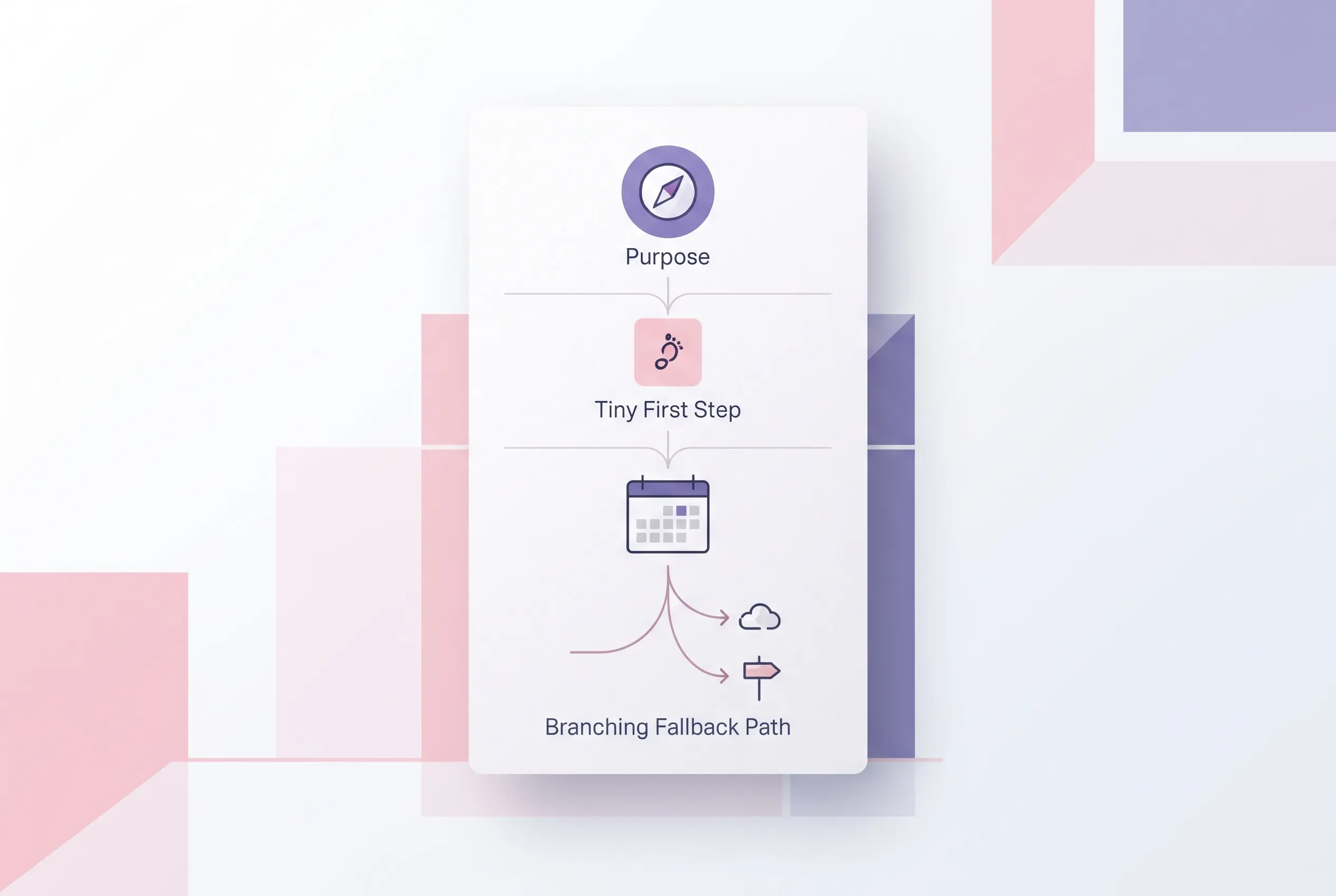
For each goal, write four things: why it matters, the first action, a checkpoint, and what you will do when the obvious obstacle appears. Keep the first action small enough that you can tell whether it happened. A plan is useful when it answers “what next?” without requiring another planning session.
Here is a fictional reading goal. It is an example, not a result from a study:
| Field | Example entry |
|---|---|
| Goal | Finish 12 books this year |
| Why | Make room for reading outside work |
| First action | Pick one book and put it by the chair |
| Weekly action | Read during two planned 20-minute windows |
| Checkpoint | At month-end, note books finished and whether the rhythm fits |
| If plans change | If an evening disappears, move one session to the weekend |
The target of 12 books is only an example. What matters is having a next action and a plan for a missed slot. If 20 minutes twice a week is too much or too little, the monthly checkpoint gives you permission to adjust it.
Use the same fields for a learning goal, a home project or a personal routine. Avoid filling the calendar with every future step. Choose the next action now, then use the review date to decide what comes after it.

What should you track between January and December?
Track only the information that helps you decide what to do next. For a repeatable action, mark whether it happened. For a measurable outcome, record the result at a sensible interval. Do not track both just because a template has room for both.
A review can be short. At the end of each month, ask: What action did I take? What made it easier or harder? Does this goal still matter? What is the next step? If your goal is to read more, a count of reading sessions may help you adjust your plan. If the goal is to finish a particular book, the finished title may be the measure that matters. HealthLink BC offers a similar practical sequence: define a goal, identify smaller steps, and make an action plan. Its guide is written for health goals, but the sequence is easy to adapt. Read its goal-setting guide.
An APA summary of a meta-analysis reports that prompting people to monitor goal progress improved goal attainment across 138 studies with 19,951 participants (Harkin et al., 2016). Recording progress or reporting it to someone else had a stronger effect in the analysis. Most studies concerned personal health goals, so this does not prove that a monthly review improves every kind of personal goal. It does support making progress visible when that information helps you act. See the APA summary and study details.
A single page can hold the goal, this month’s action and the review note. If you prefer paper, use a notebook. If you already use a calendar, reserve a recurring review time there. Tracking should make the goal easier to remember. If maintaining the tracker becomes a task of its own, simplify it. The Ultimate Life Organizer includes a goal tracker with progress bars, though a paper page or calendar can work just as well.
What if a goal stops fitting?
Change the plan when your circumstances or priorities change. A goal is not a contract that you signed with your January self. At a review, you can keep it as written, make it smaller, pause it or replace it. The useful question is whether it still deserves a place in your current life.
If you are stuck, check three things. First, is the goal still important to you? Second, is the next action clear? Third, does the plan fit the time and resources you actually have? A “no” points to a different fix: reconnect with the reason, make the step more concrete, or reduce the commitment.
You can also write down what changed. “I paused the evening class goal while my work schedule is changing” gives you more to work with than a blank progress box. At the next review, you can restart, revise or leave the goal parked. Each choice leaves you with useful information for later.

If January planning feels crowded, start with the next step rather than a perfect year map. A short list and a recurring review are enough to keep the plan visible. You can also use a weekend reset to sort what needs attention or compare life-planning formats before choosing where to keep your notes.
Why Trust This Article
Cosmo Suite sells the Ultimate Life Organizer described below, so we have a commercial interest in the topic. The study figures come from the linked PLOS ONE paper and the APA summary of a separate meta-analysis. The reading example is fictional, and the three-goal worksheet is an editorial planning aid, not a tested method or a promise of results. Read who publishes this site and how we prepare and correct articles.
Where the Ultimate Life Organizer Fits
The Ultimate Life Organizer from ultimatelifeplanner.site is a bundle of three spreadsheets for Excel and Google Sheets plus one Notion template. The Notion Life OS includes goal pages, and the Habit Tracker has annual goals. The bundle costs $9 once in the US, according to its current product configuration, and is reusable each year. It does not choose goals or guarantee that you will complete them.
If you want a ready-made place to keep a goal beside other planning areas, you can see the Ultimate Life Organizer contents. It may suit someone who already uses spreadsheets or Notion and wants a prepared set of files. A notebook, a basic calendar or a free sheet you build yourself may fit better if you want a simpler setup. The life planner overview compares formats before you decide.
Frequently asked questions
What makes a good new year goal?
A useful goal says what you want to move toward and gives you a next action you can recognize. Add a reason, a first step and a date to review it. Specific details help you see what to do, but leave room to revise the plan when circumstances change.
Should I set new year goals before January?
You can. November gives you time to think through what matters, choose a first step and prepare for likely obstacles. There is no rule that a goal must start on January 1, and research does not establish November as a better month to set one.
How many goals should I set for the new year?
There is no number that fits everyone. If a long list feels hard to act on, start with one to three goals and see whether they fit your time and responsibilities. The number is a planning choice, not a measure of ambition. The [Ultimate Life Organizer planning bundle](/) is one ready-made option if you want goals beside other parts of life admin.
What is the difference between a goal and a resolution?
A resolution is often a broad intention, such as reading more. A goal makes the intention easier to act on by naming a direction, a next step and a way to review progress. The labels vary, so focus on whether your plan tells you what to do next.
How often should I review my new year goals?
Choose a review rhythm that you can keep, such as a short monthly check. Look at the action you planned, what happened, and whether the goal still matters. Research links prompted progress monitoring with goal attainment, but the best measure depends on the goal.
Can I change a goal after the year starts?
Yes. A goal can stop fitting when your time, priorities or circumstances change. You can keep it, make the next step smaller, pause it or replace it. Write down why you changed the plan so the next review starts with context rather than guilt.
Sources
- Oscarsson et al., A large-scale experiment on New Year’s resolutions: Approach-oriented goals are more successful than avoidance-oriented goals, PLOS ONE
- Oscarsson et al., New Year’s resolutions study, PubMed record
- Harkin et al., Does Monitoring Goal Progress Promote Goal Attainment? PubMed record
- HealthLink BC, Meet Your Goals for the Year
